
Green transition in Africa is not a threat to energy security
Ole Winckler Andersen (Photo by DIIS)
Rasmus Hundsbæk Pedersen (Photo by DIIS)
The war in Iran has affected the stability of fuel supplies and led to significantly higher fuel prices. It has also led to renewed debate about the role of oil and gas in energy security. At the COP30 meeting in Belém, Brazil, in November 2025, several African countries were already warning against a roadmap for the phasing out of fossil fuels because they feared the consequences for energy access and the reliability of energy supplies. On several occasions previously, African leaders have expressed similar concerns about the implications of an accelerated transition to renewable energy for energy reliability and, ultimately, economic growth. This may also be a matter for discussion at the upcoming COP31 meeting next month in Türkiye.
We question the notion that there exists a trade-off between transitioning away from fossil fuels and the reliability of supplies. If this were the case, it would of course be particularly worrisome for countries in Sub-Saharan Africa. It is well documented that energy reliability, which is important for economic growth, is already lower in Sub-Saharan African countries than in other regions of the world. The evidence we present in what follows shows that increasing the share of renewable energy in electricity production does not undermine reliability. Indeed, it proves that in African countries that use more renewable energy, power outages and losses in the energy systems do not increase. This conclusion applies to renewable energy both with and without hydropower. It is based on available recent data on power outages (48 countries) and losses (32 countries) in Sub-Saharan African electricity systems.
Do green transitions cause more power outages?
Power outages are more prevalent in Sub-Saharan African countries than other regions of the world, where they are less frequent and often of shorter duration. Recent data from World Bank Enterprise Surveys show that more than 50 per cent of companies in Sub-Saharan Africa experience power outages each month and often have several lengthy outages. This challenge for African countries has significant implications, in particular, for small enterprises, but also for social sectors and households. To assess whether an increased use of renewables leads to more power outages in African countries, we first compared the total share of renewables in electricity production and number of outages per month. The first figure below is based on the most recent data from the International Renewable Energy Agency (IRENA) and the World Bank Group’s Enterprise Surveys. It covers the 48 Sub-Saharan African countries for which data are available.
Figure 1: Comparison of percentage share of renewables in electricity production and number of outages per month
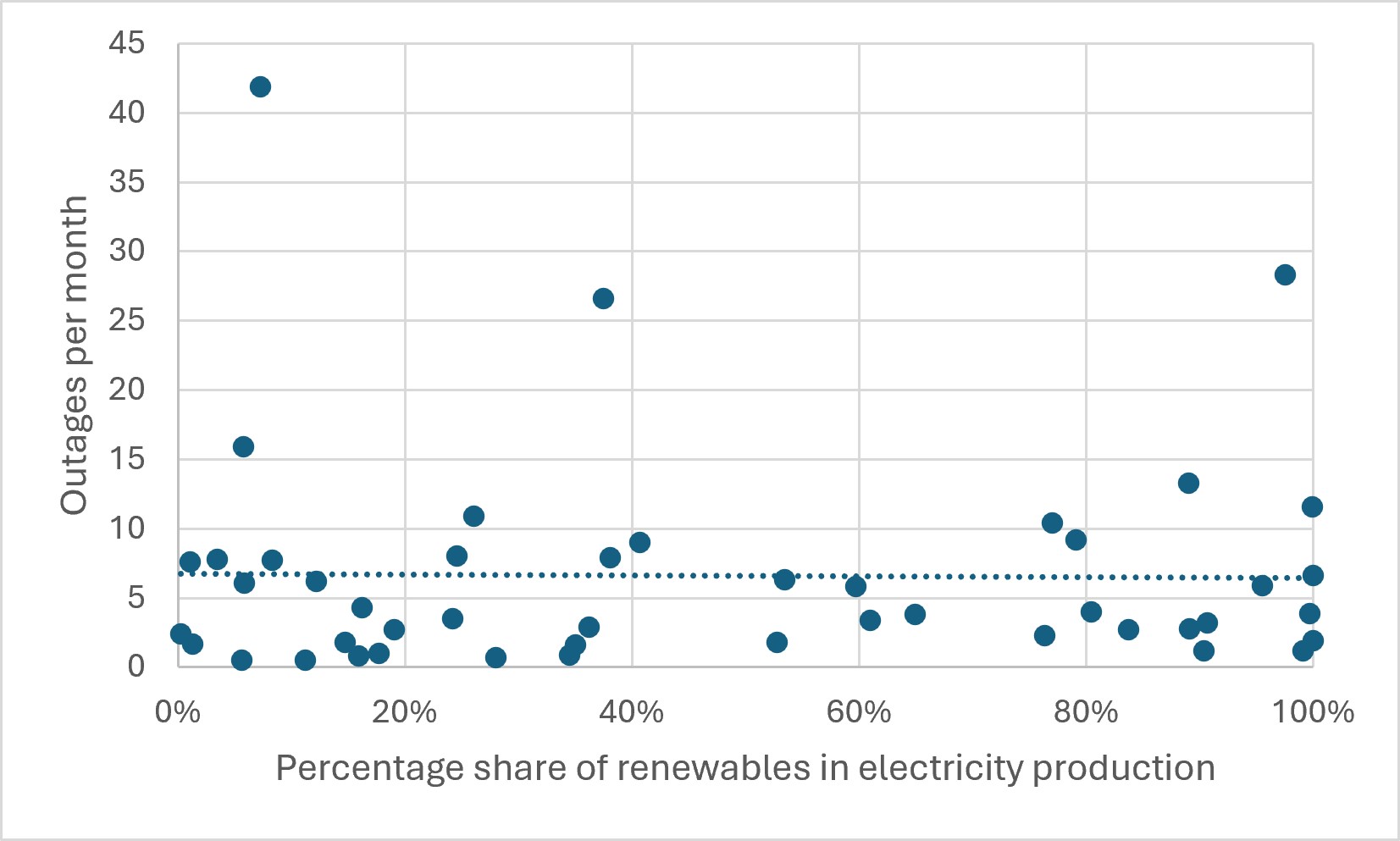
Source: IRENA and World Bank Enterprise Surveys (accessed September 2026).
As discussions have often focused on new sources of renewable energy like solar and wind, we have also made a comparison of the share of renewables without hydropower in electricity production and the number of outages per month (see Figure 2).
Figure 2: Comparison of percentage share of renewables without hydropower in electricity production and number of outages per month
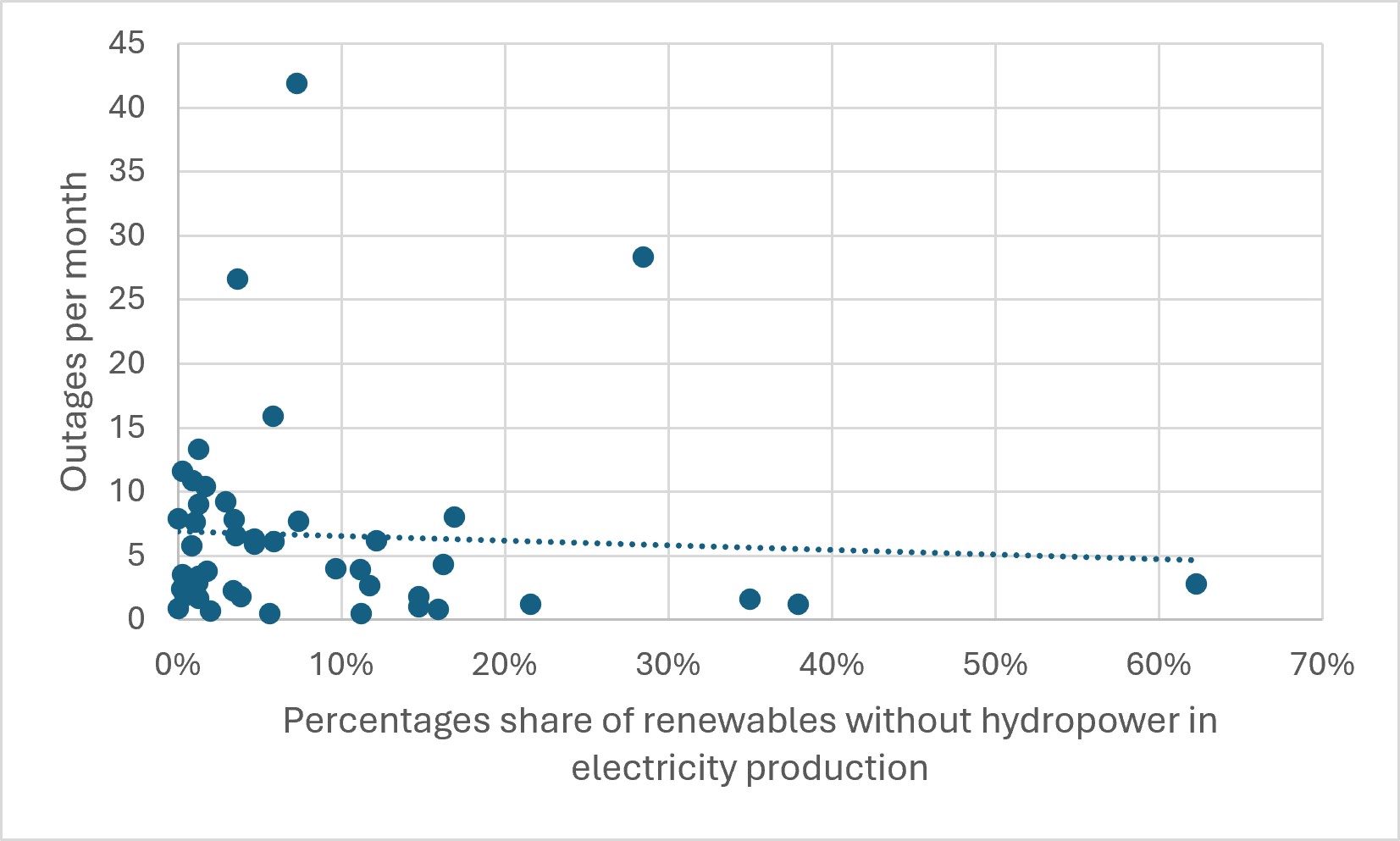
Source: IRENA and World Bank Enterprise Surveys (accessed September 2026).
Readers can see that the dotted line in the first figure is close to horizontal. It does not indicate any tendency for countries with a larger share of renewables in electricity production to have more outages per month. What happens if we increase the share of non-hydro renewable energy at the cost of fossil fuels, which is what several African leaders have objected to? Here we get a similar result, as the second figure shows, namely that even with an increase in the share of renewables without hydropower in electricity production, there is no tendency to have more outages.
Taken together, the figures show that inclusion or exclusion of hydropower makes no clear difference. Non-hydro forms of renewable energy like solar and wind are often criticized for intermittent production depending on whether the sun is shining and the wind is blowing, just as hydropower is often viewed as being an increasingly unreliable source of energy due to climate change. We have also checked other measures of power outages (length of outages and percentages of companies that experience outages per month), and we did not find that countries with more renewable electricity are hit harder by power outages. In other words, the concern that increased use of renewables in electricity production will lead to more power outages is unfounded.
Do green transitions lead to higher losses in electricity production?
Another indicator of the quality of electricity systems is the scale of losses in the system. Losses in electricity systems in Sub-Saharan Africa have on average been approximately 15 per cent of electricity supply for several years. The comparable figure for European countries is 6-7 per cent. Whether increased use of renewable electricity leads to higher losses is the focus of Figure 3 and Figure 4. The figures are based on recent data from IRENA and the International Energy Agency (IEA). As above, they compare the renewable share of electricity production with and without hydropower with the percentage of losses in electricity supply. The figures cover 32 countries in Sub-Saharan Africa for which data are available.
Figure 3: Comparison of percentage share of renewables in electricity production and losses as a percentage of energy supply
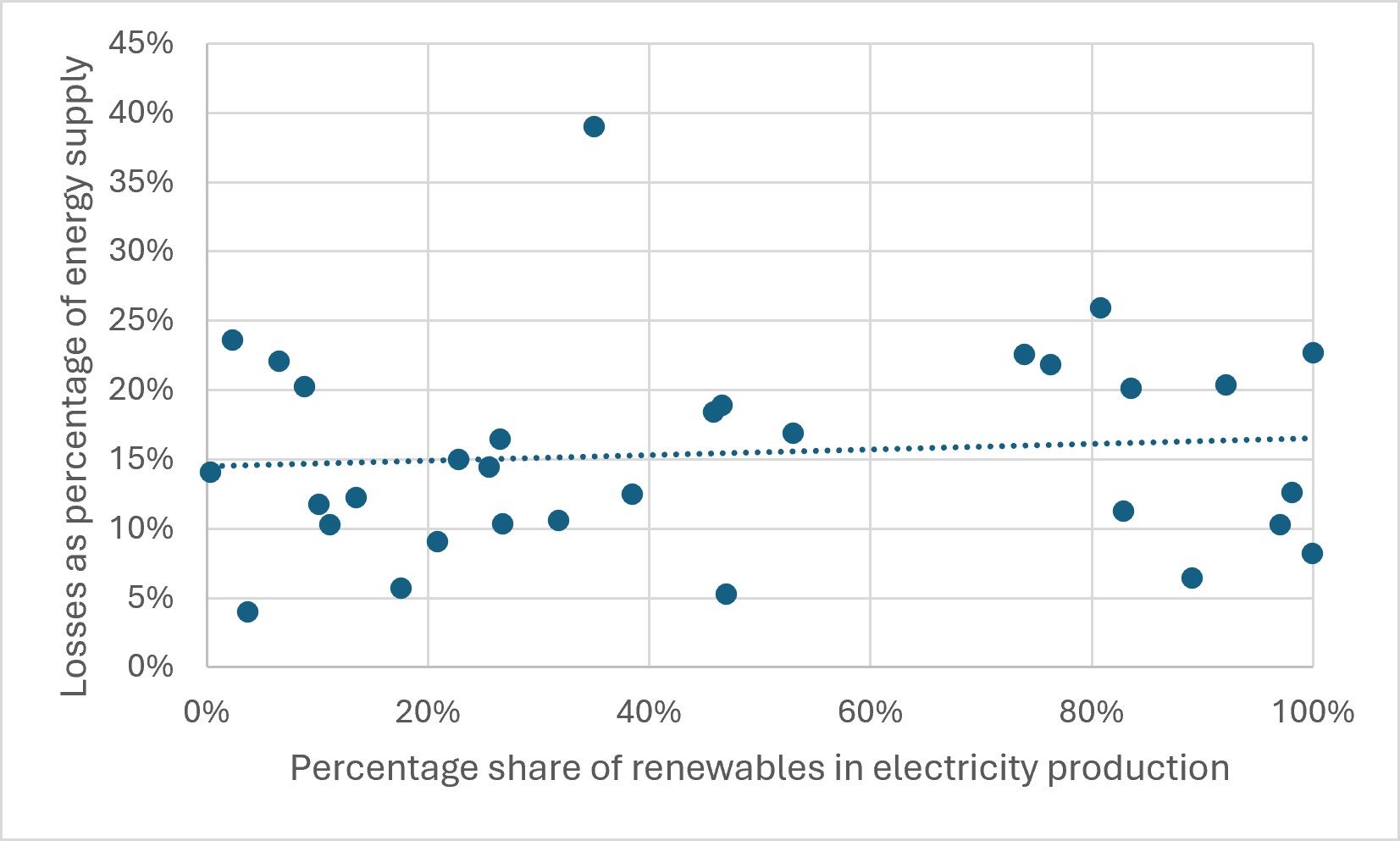
Source: IRENA and IEA (accessed September 2026).
Figure 4: Comparison of percentage share of renewables without hydropower in electricity production and losses as a percentage of energy supply
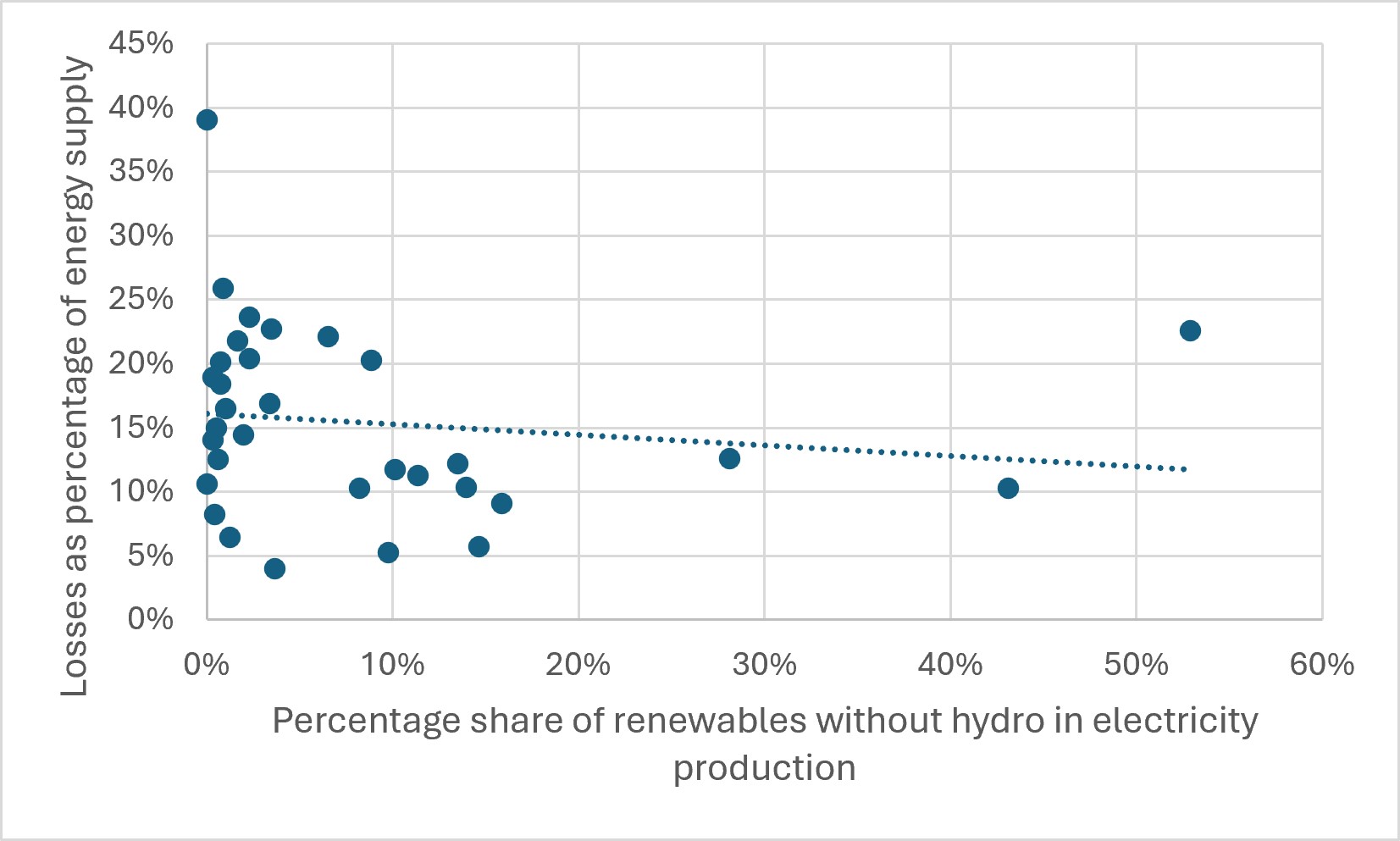
Source: IRENA and IEA (accessed September 2026).
Again, the dotted lines are close to being horizontal, and the figures show no clear tendency for countries with more renewable electricity to have higher losses in their energy systems. As in the first two figures, there is significant variation among the countries. Several factors can obviously influence the size of losses in electricity systems, but in general the increased use of renewables in electricity production does not seem to affect the losses in the systems, and this applies to renewables both with and without hydropower.
Future challenges
Countries in Sub-Saharan Africa that use more renewables in electricity production seem to be able to manage power outages and losses as well as countries that do not. This applies whether we focus on new renewable forms of energy like solar and wind, which is what many in Africa worry about, or include hydropower. However, this conclusion is based on overall trends, and it reflects significant variations among individual countries. Several country-specific factors can influence both power outages and losses in African electricity systems.
Although the available data do not suggest that green transitions have adverse effects on power outages and losses in electricity systems, the design of green transitions must obviously reflect the specific country contexts in terms of resource endowments, management capacity and availability of financing. Moreover, some countries may need more time to significantly reduce and eventually phase out fossil fuels.
It is also worth noting that the share of renewables in electricity production is still low in most countries and, although it is sharply increasing, on average only constitutes about 25 per cent. The share is much lower for electricity production using non-hydro renewables. A higher share and increasing pace of green transitions – for instance, due to the current Middle East war – will create several challenges. An altered mix between renewable and non-renewable energy sources will require better, and adjusted energy-sector management. Significantly increased investments and probably new types of finance will also be needed, not only in electricity production, but also in transmission and distribution systems.
Irrespective of the degree to which renewables are used in electricity production, power outages and losses are still significant challenges in African energy sectors. International donors and investors could do much more to assist countries in this regard. Yet, according to data from the OECD, international donors have kept their support to transmission and distribution more or less constant in the last ten years, while support for electricity production, especially using renewable sources, has increased.
__________________________________________
Ole Winckler Andersen is Senior Analyst at the Danish Institute for International Studies.
Rasmus Hundsbæk Pedersen is Senior Researcher at the Danish Institute for International Studies.