
Opinion
FAO: Fund adaptation before climate shocks become food crises
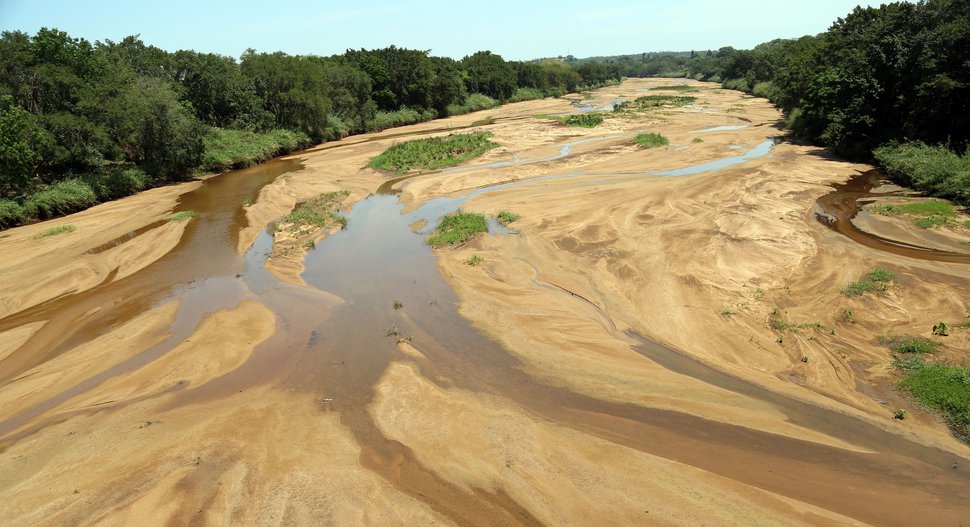
Great Usuthu River in Swaziland during the El Niño of 2016. (Photo by FAO)
We have become increasingly effective at mobilizing resources after disaster strikes. Yet we still struggle to finance investments that could reduce the damage before it happens.
This is one of the central contradictions of climate finance. We pay for lost harvests, damaged infrastructure and emergency assistance, but invest too little in preventing those losses in the first place.
For agriculture, the economic cost is already enormous. FAO estimates that disasters caused around USD 3.8 trillion in crop and livestock production losses over the three decades to 2021, equivalent to an average of USD 123 billion a year. And this estimate does not fully capture losses in fisheries, aquaculture and forestry.
At the same time, the resources available for adaptation remain far below what is needed. UNEP estimates that developing countries will require USD 310 billion to USD 365 billion a year for adaptation by 2035, while international public adaptation finance flows were only USD 26 billion in 2023. In other words, estimated needs are already 12 to 14 times current flows.
This financing gap is ultimately also about who carries climate risk.
 Small-scale farmers, pastoralists and fishers are among those most exposed to droughts, floods and changing weather patterns, yet they often have the fewest resources to protect themselves. When production collapses, those losses do not remain on the farm. They affect food supplies, incomes and local economies, while governments and the international community are called upon to finance emergency assistance and recovery.
Investing earlier can change that equation.
Adaptation means investing in better water management before drought intensifies, restoring soils and ecosystems, providing access to resilient crops and appropriate technologies, improving climate information, and helping producers diversify production and income. But these measures work best when they are connected rather than financed as isolated projects. A resilient seed has limited value without water; irrigation cannot reach its potential on severely degraded soil; climate information achieves little if farmers lack the resources to act on it.
There is evidence that this kind of investment can work. In the Bicol Region of the Philippines, one of the country's most disaster-prone regions, FAO and the Department of Agriculture introduced and tested stress-tolerant Green Super Rice varieties in communities exposed to drought, flooding and saltwater intrusion. FAO subsequently used the Bicol experience in its work assessing the benefits and costs of farm-level disaster-risk-reduction practices.
The lesson is important: adaptation should not be seen only as protection against climate change. It is investment in productive capacity.
This is where COP31 can make a practical difference.
Rather than financing a succession of stand-alone adaptation projects, governments, climate funds and development banks should increasingly finance integrated national agrifood adaptation programmes, built around countries' National Adaptation Plans and agricultural investment strategies.
Such programmes should combine water, soils, resilient agriculture, ecosystems, climate information, infrastructure, finance and skills around common national priorities. They should also bring ministries of agriculture, environment and finance together with development banks, producers' organizations, research institutions and the private sector.
This approach would also change how we measure success. The question should not simply be how much adaptation finance has been mobilized or how many projects have been approved. We should ask: How much vulnerability has been reduced? How much productive capacity has been protected? How many farmers are better able to withstand the next drought or flood? And, critically, how much damage has not occurred because we invested earlier?
This is particularly important because adaptation finance cannot rely on public resources alone. UNEP estimates that the private sector could potentially provide around USD 50 billion annually for adaptation, if supported by appropriate policies and blended-finance approaches. Public finance should therefore also help reduce risk and create the conditions for responsible private investment in resilience.
Farmers cannot carry the cost of a changing climate alone. Nor should governments and international institutions repeatedly absorb avoidable losses after each crisis.
We need to reverse the logic.
For too long, we have measured our capacity to confront climate shocks by how effectively we respond once damage has occurred. We need a more ambitious measure: how much damage we prevent because we invested in resilience before the crisis.
The choice is straightforward. We can continue paying repeatedly for losses, recovery and emergency assistance. Or we can invest in stronger soils, better water management, resilient agriculture, functioning ecosystems, innovation and people.
Adaptation is not simply the cost of responding to climate change. It is an investment in our capacity to feed the world despite it.
___________________________
Maurizio Martina is Deputy Director-General of the UN Food and Agriculture Organization