
Norwegian government heads for a risky parliamentary showdown on TFFF
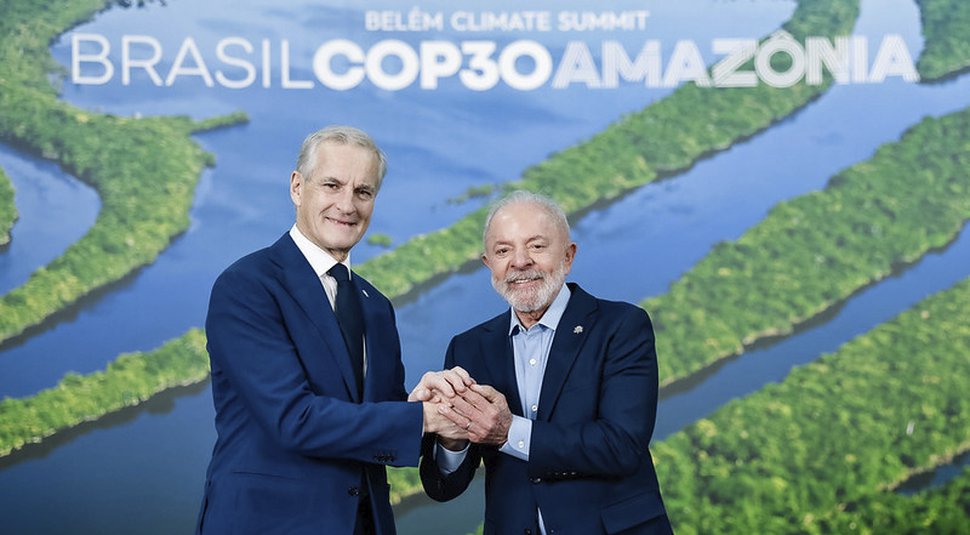
Norwegian Prime Minister Jonas Gahr Støre (left) pledged NOK 30 billion to the Tropical Forest Forever Facility at COP30 in Belém last year. Here, with Brazilian President Luiz Inacio Lula da Silva. (Photo: Ricardo Stuckert)
The government will not enter into an agreement that “commits the state before Parliament has received a briefing and approved an appropriation,” states a letter from the Ministry of Finance to the Conservative Party’s parliamentary group, obtained by Development Today.
“It is good that the government is now backing down. The proposal was neither adequately prepared nor ready for consideration by Parliament,” the Conservative Party’s fiscal policy spokesperson Nikolai Astrup says to Development Today.
In the revised national budget, the government requested authorisation to commit the state to disburse a NOK 30 billion loan to TFFF, the rainforest fund that Norway is set to co-lead together with Brazil. The loan was to be disbursed over a ten-year period. The four opposition parties, the Conservatives, Liberals, Christian Democrats, and Progress, are refusing to grant the government this lending authority.
This suggests that the broad political alliance that has traditionally supported giant Norway’s rainforest initiative, launched in 2008, is beginning to show signs of strain. The Conservatives, Christian Democrats and Liberals have been core members of this alliance.
The rainforest initiative is Norway’s largest development assistance programme, and the proposed loan to TFFF would, if approved, become the single largest initiative in the programme’s history. It is difficult to see how the government could approve such a loan without at least some support from the opposition, given that the funds would be disbursed over a ten-year period.
Sverre Vatnar, fiscal policy adviser to the Christian Democrats, confirms that his party opposes granting the government authorisation to provide a loan commitment to TFFF. He describes the proposal as “irresponsible.”
“There is a significant risk that the state could lose the entire amount,” Vatnar says.
This means that the entire opposition is opposed to granting the government authority to issue a loan commitment. As previously reported, Prime Minister Jonas Gahr Støre did not consult the opposition before pledging the NOK 30 billion loan to TFFF at the climate summit in Brazil in November.
Commenting on the government’s u-turn, Astrup says: “It reflects poor professional judgment and poor political craftsmanship on the part of the Prime Minister to seek a blank cheque worth NOK 30 billion without being able to answer basic questions [about risks]. When the Prime Minister wants to make such a large and long-term aid commitment, he should ensure broad support in Parliament and that the proposal has been thoroughly scrutinized and quality-assured.”
Economists have described the fund as a “gamble,” and in a series of articles, Development Today and Rundskue24 have highlighted the risks associated with TFFF. The fund aims to raise USD 25 billion in core capital, most of it through sovereign loans. So far, it has secured pledges for only a quarter of that amount, with more than 40 per cent coming from Norway. In addition, TFFF plans to borrow USD 100 billion from private investors and invest the capital in bonds, primarily in emerging markets.
In the revised budget, the government requests authorisation to “commit the state” to disburse the loan to TFFF. Its proposed parliamentary decision read as follows: “Parliament consents that the government in 2026 may enter into an agreement committing the state to a loan of up to NOK 30 billion” to TFFF.
The minority Labour government leans on four parties - often labelled the “Tutti-frutti parties,” Centre, the Greens, Socialist Left and the Red Party - to have its budget approved. The final text of the four-party agreement on the budget does not mention TFFF.
This probably means that, formally, the authorisation to enter into an agreement still stands. However, since the government now says it will not enter into a legally binding agreement but will first seek approval in Parliament, it will be dependent on shoring up support from all its four budget partners.
The loan would be disbursed during the period 2026–2035, provided that certain conditions for Norwegian participation are met: at least USD 10 billion in core capital must be mobilised by the end of the year; Norway’s contribution must not exceed one-fifth of the total; and the fund must have a sustainable financing model.
Last month, the Conservative Party submitted 13 questions to the government about the fund but was not satisfied with the responses from the Finance Ministry.
“The government is unable to answer even the most basic questions, such as what risks it is taking. In practice, the prime minister is asking for a blank cheque worth NOK 30 billion,” Astrup told Rundskue24.
In a follow-up question, the Conservatives requested clarification about the legal implications of the “condition regarding a sustainable financing model” contained in the parliamentary authorisation. “We want to know what is legally required for the conditions in the authorisation to be considered fulfilled,” the party wrote.
In its recent letter to the Conservatives, the Ministry of Finance reiterates that there remain “several unresolved issues regarding the structure” of TFFF and that a financial adviser has been engaged to assist in developing the financing model and the fund’s investment mandate. “This means that the risk Norway is assuming has not yet been clarified … a sustainable financing model should generate the highest possible return within an acceptable level of risk” for the core capital that Norway contributes.
The ministry’s letter now confirms that the government will not enter into “an agreement that has legal effect, that is to say, commits the state, before Parliament has received a briefing and approved an appropriation.”
The ministry adds that the government may still enter into an agreement with Brazil that is subject to parliamentary approval.
At the same time, the TFFF matter has turned into a war on messaging. Asked to comment on these developments, the Climate Ministry denies that the government is backing down on an authorisation from Parliament to enter into a loan agreement for TFFF and says it is not “making a u-turn.”
The government states in the revised budget proposal that it will come back to Parliament asking for a budget allocation once the government considers the conditions to have been met, a spokesperson at the Climate Ministry says. “The Ministry of Finance reconfirmed this to the Conservatives in their letter,” she says.
“It does not matter what the ministry calls this ‘u-turn’, as long as Parliament is given the opportunity to properly consider Prime Minister Støre’s lofty promises,” says Astrup.